What is a natal chart???????
A natal chart — also called a birth chart, a horoscope (in the old, literal sense), or in Sanskrit a kundli — is a diagram showing exactly where every visible planet was in the sky at the exact moment you were born. The diagram is drawn from the perspective of the exact location on Earth where you took your first breath. It is, in the most literal possible sense, a photograph of the heavens taken at the moment you arrived in them. (part of our astrology) Part of our astrology library library.
The reason this matters in astrology is one of the field's oldest premises: that the configuration of the cosmos at the moment of your birth carries information about your nature, your patterns, your relationships, your callings, and the shape of the life you are likely to live. Astrologers do not generally claim the planets cause these things. The deeper view, articulated by everyone from the Hellenistic astrologers of the second century to the modern psychoanalyst Carl Jung, is one of correspondence. The cosmos and the soul move in resonance. What happens in the sky reflects what is happening in the soul, and vice versa. The natal chart is the most precise map we have of how that resonance is configured for you specifically.
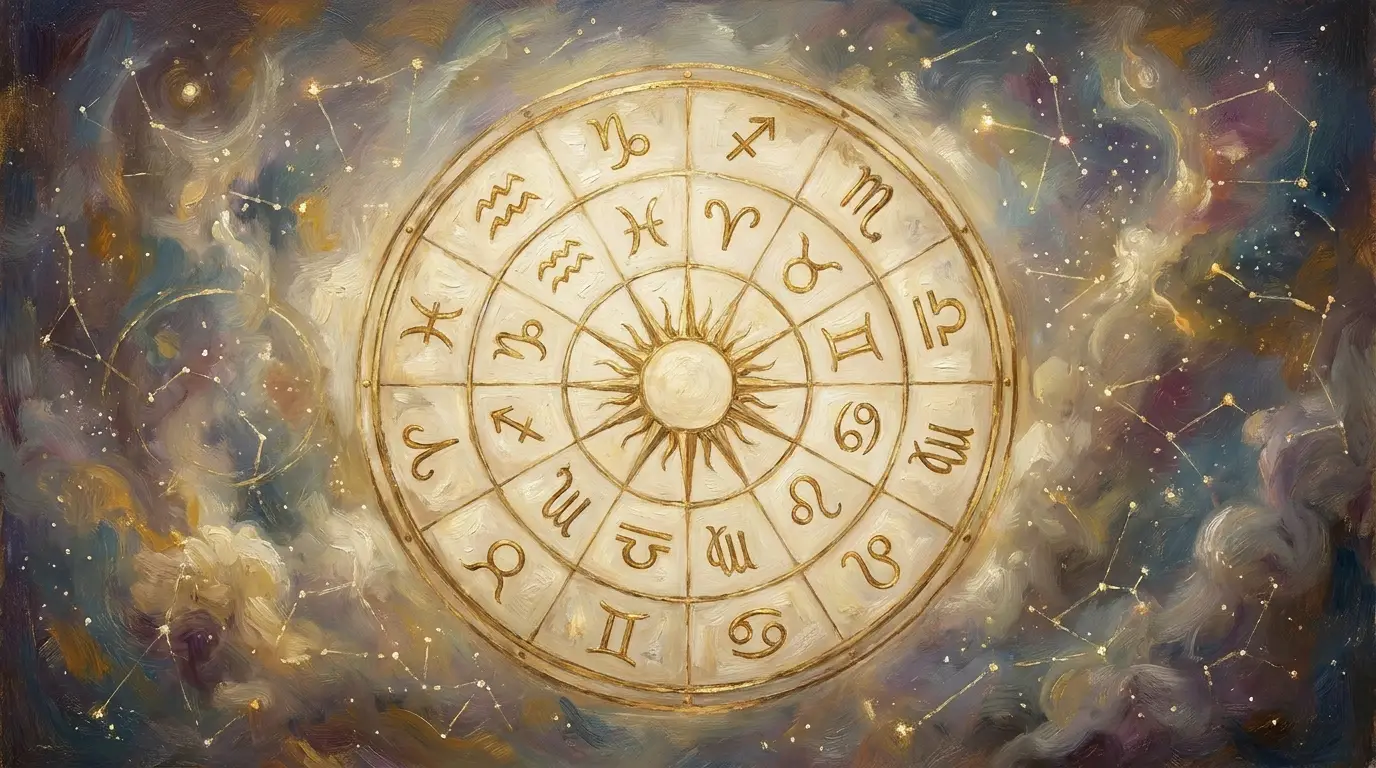
Practically, a natal chart looks like a circle — a wheel divided into twelve segments. Around the outer edge are the twelve signs of the zodiac. Inside the wheel are the symbols (called glyphs) of the ten planets — the Sun and Moon plus Mercury, Venus, Mars, Jupiter, Saturn, Uranus, Neptune, and Pluto. Connecting some of the planets are coloured lines representing aspects — the geometric relationships between planets that astrology considers significant. The whole thing reads, once you know the language, as a kind of musical score. You can hear the harmonies and the tensions; you can see where the music swells and where it hesitates.
The natal chart never changes. It is the one astrological fact that is fixed for your entire life. Every other astrological reading — your annual forecast, your transit predictions, your synastry readings with another person — is calculated relative to this foundational document. It is the bedrock under everything astrology says about you. Part of our astrology library library. Part of our astrology library library. Part of our astrology library library. Part of our astrology library library.
The three things you need
To calculate your natal chart accurately, you need exactly three pieces of information: See how Raka compares to other apps in our independent guide.
1. Your date of birth. Day, month, year. This determines the positions of the slower-moving planets — Jupiter, Saturn, and the outer planets — which often stay in the same sign for months or years. Just from your birth date, an astrologer can already place the majority of your planets in their signs.
2. Your time of birth, ideally down to the minute. This determines two of the most important elements in your chart: your Ascendant (your Rising sign) and your exact Moon placement. The Ascendant changes every two hours throughout the day, and it shapes the entire chart's house structure. Without precise birth time, your chart cannot tell you which areas of life each planet operates in. Most people find their birth time on their birth certificate, in a baby book, or by asking a parent. If you genuinely cannot find it, see the section on solar-house charts below.
3. Your place of birth — city is enough. The location determines the latitude and longitude used to calculate the Ascendant, the Midheaven (top of the chart), and the house cusps. The closer the city to where you were actually born (e.g. a specific hospital), the more precise the chart, but for almost all purposes the birth city is enough.
With those three pieces of information, any astrology software — or any traditional astrologer with an ephemeris and a table of houses — can calculate your complete natal chart in under thirty seconds. The Raka app does this from the onboarding screen; most online tools will do it in roughly the same time. The Raka chart feature is part of the app's free tier.
If you do not know your birth time, you still have options. You can do a solar-house chart, which uses your Sun as the Ascendant and gives you a serviceable but less precise reading. You can also work with an astrologer who specialises in chart rectification — the process of working backwards from known events in your life to estimate the most likely birth time. Rectification is real, and good rectifiers can land within a few minutes of accuracy. But the simplest path remains finding the actual birth time if at all possible.
The anatomy of a natal chart
Once you have your chart in front of you, the first thing to do is learn to read its anatomy. A natal chart has four layers, each adding more detail:
The wheel itself. The chart is drawn as a 360-degree circle, divided into twelve equal segments. These segments are the houses. Each house represents a different area of life — your identity, your money, your relationships, your work, your home, and so on. The houses do not change between people; the same numbered house always means the same thing. What changes is which planets are in which houses, and which sign rules each house — which is set by your Ascendant.
The zodiac ring. Around the outer edge of the wheel are the twelve signs of the zodiac: Aries, Taurus, Gemini, Cancer, Leo, Virgo, Libra, Scorpio, Sagittarius, Capricorn, Aquarius, Pisces. The signs rotate around the wheel based on your Ascendant. The sign on the left horizon line of the chart (the 9 o'clock position) is your Rising sign — the first house cusp. The signs continue counter-clockwise from there.
The planets. Inside the wheel, marked with their glyphs, are the ten planets. Each planet sits in one specific sign and one specific house at the moment of your birth. A planet's sign describes how it expresses (the planet's "costume"); a planet's house describes where it expresses (which area of life it animates).
The aspects. Lines drawn between planets inside the wheel show their angular relationships. The most important aspects are the conjunction (0°), opposition (180°), trine (120°), square (90°), and sextile (60°). Each aspect indicates how those two planets interact — easily, with friction, with intensity, with creative tension. Aspects are where charts get interesting.
Reading a chart well means moving between these four layers fluently. The sign tells you the texture of the planet. The house tells you the field of life it shows up in. The aspect tells you who it is in conversation with. The Ascendant ties it all together by setting the framework.
The chart is, in the most literal possible sense, a photograph of the heavens taken at the moment you arrived in them.
The Big Three — Sun, Moon, Rising
If you have ever heard someone say "I'm a Pisces Sun, Cancer Moon, Scorpio Rising," they are giving you their Big Three. These three placements — the Sun sign, the Moon sign, and the Rising sign (Ascendant) — are the single most useful shorthand for capturing the texture of any person's chart. Once you know your Big Three, you have most of the practical material astrology has to offer.
Your Sun sign is what most people mean when they say "I'm a Scorpio" or "I'm a Libra." It is the sign the Sun was passing through on the day you were born, and it changes only once a month. The Sun in astrology represents your core identity, your ego, your conscious sense of self, your vitality, your father figure, your purpose. It is the centre around which the rest of you orbits. If your Big Three is the chord, the Sun is the root note.
Your Moon sign is the sign the Moon was passing through at your birth, and because the Moon moves quickly — through one sign every 2.5 days — your Moon sign captures something more intimate than your Sun. The Moon in astrology represents your emotional life, your unconscious, your inner world, your relationship with your mother, your habits of comfort and rest, your needs. People who know their Big Three often say the Moon is the placement that most matches how they actually feel inside, especially when no one is watching. The Sun is who you are; the Moon is what soothes you.
Your Rising sign — your Ascendant — is the sign that was rising on the eastern horizon at the exact moment of your birth. It changes every two hours, which is why precise birth time matters so much. The Ascendant represents the face you show to the world, your physical appearance and first impression, the doorway through which you engage life. People often experience their Rising sign as the version of themselves they put on at parties, at work, in any first meeting. The Sun is who you are; the Moon is what you feel; the Rising is what people see first.
The interaction between these three is where things get interesting. A person with a Scorpio Sun, Pisces Moon, and Aquarius Rising is a fundamentally different creature from a Scorpio Sun, Capricorn Moon, Aries Rising person — even though they share the headline. The Big Three is the chord, not the note.

Reading your own chart is a slow, returning practice. Most people get the basic Big Three in an evening — and then spend months noticing what the rest of the placements actually mean in their lives.
The ten planets and what each means
Astrology counts ten "planets," though technically the Sun is a star and the Moon is a satellite. The grouping is historical: the seven visible-to-the-naked-eye bodies plus the three modern outer planets discovered in the last few centuries. Each carries a specific symbolic meaning that has been refined over more than two thousand years.

The Sun is your core self, the centre around which everything else orbits. It represents your conscious will, your sense of who you are, your vital energy, and the role of the father (or father-figures) in your life. When the Sun is strongly placed in your chart, you have an unmistakable centre of gravity to your personality.
The Moon is your inner emotional life, your unconscious patterns, your habits of self-soothing, and your relationship with the mother. It moves the fastest of all the chart's bodies — through a sign every 2.5 days, through the full zodiac every 28 days. Your Moon sign describes what makes you feel safe.
Mercury is the planet of thought, speech, writing, learning, and short-distance movement. It rules your intellectual style, how you communicate, how you take in new information, and your relationships with siblings. Mercury never moves more than 28° from the Sun, so your Mercury sign is always within one or two signs of your Sun.
Venus rules everything that pleases — love, beauty, aesthetics, music, art, sweetness, sensuality, and the things you value. It also has a financial dimension, representing the money that flows toward what brings you joy. Your Venus sign tells you what you find beautiful and how you express love.
Mars is the planet of drive, action, willpower, anger, sex, and the way you fight for what you want. It represents your assertion, your courage, your edge. Your Mars sign tells you how you pursue, how you compete, and how you express anger when it arises.
Jupiter is the great benefic — the planet of expansion, generosity, wisdom, teachers, higher learning, and the experience of luck. Wherever Jupiter sits in your chart is an area of natural abundance and ease. Your Jupiter sign tells you where you grow without forcing it.
Saturn is the great teacher of structure and discipline. It represents responsibility, limitation, time, mastery through effort, and the lessons that come slowly. Wherever Saturn sits in your chart is an area where you must build through patience and where, eventually, you become an authority. Your Saturn sign describes the shape of your maturity.
Uranus is the planet of sudden breakthrough, innovation, freedom, and disruption. It stays in each sign for about seven years, so your Uranus sign describes a generational quality. The house Uranus sits in for you specifically is more personal — it is the area of life where you most need freedom and where you will likely break with convention.
Neptune dissolves edges. It is the planet of mysticism, dream, intuition, art, and also of confusion and illusion. Neptune stays in each sign for about fourteen years; your Neptune sign is generational. The house Neptune sits in shows where you most easily lose yourself — in beautiful ways and sometimes in difficult ones.
Pluto is the planet of deep transformation, hidden power, what dies and what is reborn. It stays in each sign for around twenty years; your Pluto sign is a profound generational marker. The house Pluto sits in for you is the area of your life that will undergo the most profound transformation across the years.
The twelve signs in two paragraphs each
The signs are the costumes the planets wear. Each sign carries a temperament and an elemental quality — fire (Aries, Leo, Sagittarius), earth (Taurus, Virgo, Capricorn), air (Gemini, Libra, Aquarius), or water (Cancer, Scorpio, Pisces). Each sign is also cardinal (initiating), fixed (sustaining), or mutable (transitioning). The element and mode together give you the texture.
Aries (Mar 21 – Apr 19) · Fire, cardinal. The pioneer, the initiator, the warrior. Aries energy is the spark that starts everything. Direct, courageous, impatient, often pioneering. Aries placements push forward; the shadow is acting before thinking. Taurus (Apr 20 – May 20) · Earth, fixed. The builder, the sensualist, the patient gardener. Taurus energy is steady, embodied, and grounded in beauty and material reality. Taurus placements settle in for the long haul; the shadow is stubbornness and resistance to change.
Gemini (May 21 – Jun 20) · Air, mutable. The communicator, the connector, the eternal student. Gemini energy is curious, quick, conversational, and endlessly interested in what's next. The shadow is restlessness and the inability to land. Cancer (Jun 21 – Jul 22) · Water, cardinal. The nurturer, the home-maker, the keeper of emotional life. Cancer energy is protective, tender, and deeply rooted in family and feeling. The shadow is over-attachment and difficulty letting go.
Leo (Jul 23 – Aug 22) · Fire, fixed. The performer, the lion, the heart. Leo energy is warm, generous, dramatic, and devoted to creative expression. Leos love openly and want to be seen. The shadow is pride and the need to be the centre of attention. Virgo (Aug 23 – Sep 22) · Earth, mutable. The craftsperson, the analyst, the servant. Virgo energy is precise, helpful, refining, and dedicated to making things work. The shadow is criticism and perfectionism.
Libra (Sep 23 – Oct 22) · Air, cardinal. The diplomat, the artist, the lover of beauty and balance. Libra energy is relational, fair, and oriented toward harmony. The shadow is indecision and people-pleasing. Scorpio (Oct 23 – Nov 21) · Water, fixed. The depth-diver, the alchemist, the keeper of secrets. Scorpio energy goes where others won't — into the buried, the intense, the transformative. The shadow is jealousy and the urge to control.
Sagittarius (Nov 22 – Dec 21) · Fire, mutable. The philosopher, the explorer, the wisdom-seeker. Sagittarius energy is expansive, optimistic, freedom-loving, and questing for meaning. The shadow is preachiness and avoidance of commitment. Capricorn (Dec 22 – Jan 19) · Earth, cardinal. The builder of legacy, the elder, the climber. Capricorn energy is disciplined, ambitious, patient, and oriented toward long-term mastery. The shadow is coldness and over-identification with achievement.
Aquarius (Jan 20 – Feb 18) · Air, fixed. The visionary, the rebel, the keeper of the future. Aquarius energy is innovative, humanitarian, intellectual, and often ahead of its time. The shadow is emotional detachment. Pisces (Feb 19 – Mar 20) · Water, mutable. The mystic, the dreamer, the artist, the empath. Pisces energy dissolves boundaries between self and world. The shadow is escapism and difficulty maintaining a stable sense of self.
The twelve houses — where life actually happens
If the signs are the costumes and the planets are the actors, the houses are the stages. The twelve houses represent the twelve domains of life. Each one is "ruled" by the sign sitting on its cusp (the line that begins it), and the planets that fall within it animate that area of your life.
1st House — Self. Your identity, body, appearance, first impressions, your overall vitality. The cusp of the 1st house is your Ascendant. Planets here are loud — they show up in how you present yourself to the world.
2nd House — Resources. Money, possessions, values, what you call your own. Self-worth and material worth are connected in this house. Your relationship with security lives here.
3rd House — Communication. Mind, speech, writing, siblings, neighbours, short journeys, daily learning. Planets here influence how you communicate and how you process information.
4th House — Home. Mother, home, family of origin, roots, ancestry, real estate, the deepest emotional foundation. The bottom of the chart. This is the most private space in the chart.
5th House — Creativity. Children, romance, creative expression, fun, play, performance, what you create from joy rather than obligation. The house of the heart's overflow.
6th House — Daily life. Work routines, daily habits, health, service, pets, the body's small daily care. Where the rubber meets the road.
7th House — Partnerships. Marriage, business partners, close one-on-one relationships, open enemies. The cusp of the 7th is your Descendant, opposite your Ascendant. The other person in any committed dyad shows up here.
8th House — Transformation. Shared resources, sex, death, inheritance, occult knowledge, deep psychological change. The hardest house to read, the richest to live with.
9th House — Meaning. Higher learning, long-distance travel, religion, philosophy, publishing, foreign cultures, the search for ultimate meaning. Where you find your worldview.
10th House — Vocation. Career, public reputation, status, life direction, the father (sometimes), the cusp is your Midheaven. The top of the chart — where you are most visible.
11th House — Community. Friends, networks, groups, hopes, wishes, broader social vision, the fruits of your work coming in. Where what you've built becomes part of something larger.
12th House — Dissolution. The unconscious, isolation, hospitals, foreign lands, spirituality, what is hidden, what dissolves, what is given up. The most mystical house.
When you read your chart, you read where each planet sits — both its sign and its house. A Sun in Aries in the 10th house is fundamentally different from a Sun in Aries in the 4th house. The sign tells you the temperament; the house tells you where in your life that temperament actually lives.
See your full natal chart with Raka
The Raka app calculates your complete natal chart in thirty seconds — every planet, every sign, every house, plus your Big Three explained in plain English. iOS & Android, free to start.
Aspects — how planets talk to each other
Once you can locate planets by sign and house, the next layer of reading the chart is aspects — the geometric angles formed between planets. Aspects are how astrology describes the relationships between the parts of your psyche. Two planets in aspect to one another are in conversation; their meanings braid.
The five major aspects are:
Conjunction (0° — planets in the same place). The two planets blend their energies completely, for better or worse. A Sun-Venus conjunction adds warmth and charm; a Mars-Saturn conjunction adds discipline to action but can feel constrained. Conjunctions are intense and unavoidable.
Opposition (180° — planets opposite each other). The two planets pull in different directions and force you to integrate them. Oppositions create tension that, when worked with, generates depth. The opposition is the classic engine of personal growth.
Trine (120° — planets in the same element). The two planets flow together easily, often so easily that the gifts they bring are taken for granted. Trines are talents that don't feel earned. They are gentle and abundant.
Square (90° — planets at right angles). The two planets create friction. Squares are challenges that, when worked through, produce the most dramatic growth in a chart. The hard aspect is also the productive aspect.
Sextile (60° — planets two signs apart). The two planets offer opportunity but require some effort to activate. Sextiles are gifts you have to reach for.
When reading aspects, look at which planets are involved (what parts of you are talking), what aspect connects them (how they're talking), and how tight the angle is (a 0° conjunction is much stronger than a 5° one). The orb — the allowable distance from exact — varies by tradition; most modern astrologers use orbs of 6-8° for major aspects involving the Sun and Moon, and tighter orbs for the outer planets.
Common chart configurations worth knowing
Beyond individual aspects, certain configurations of three or more planets — called chart patterns — recur across charts and shape the entire personality. Recognising the major patterns will help you make sense of a chart faster than working planet by planet.

Stellium. A stellium is three or more planets in the same sign (or sometimes the same house). The energy of that sign becomes overwhelming in the personality. A Scorpio stellium person is unmistakably Scorpionic, even if their Sun is in another sign. Stelliums concentrate destiny — they often mark a person who has a clear vocation or theme that runs through their whole life.
Grand trine. Three planets forming a triangle of 120° trines to each other, usually in the same element (all fire, all earth, all air, or all water). A grand trine is the chart's classic gift placement — flowing talent, easy grace in that elemental territory. The shadow is that the gift can feel too easy and the person doesn't develop it, because it never demanded much from them.
T-square. Two planets in opposition (180°) with a third planet squaring (90°) both of them — forming a T shape on the wheel. The T-square is the chart's classic engine of growth. The friction it generates produces accomplishment, but at the cost of comfort. Many of history's most driven people have prominent T-squares. The opportunity is to channel the friction into work; the danger is to let it become anxious tension that never resolves.
Grand cross. Four planets at 90° intervals around the chart, forming a square. Considered one of the most challenging configurations because the tension never finds a still point. People with grand crosses often live unusually intense lives and produce unusual amounts — but they pay for it in nervous energy.
Yod (Finger of God). Two planets in sextile (60°) both quincunxing (150°) a third planet — forming a long narrow triangle that points at the third planet. The yod indicates a peculiar fated quality in the chart, a placement the person is "supposed" to do something with. People with prominent yods often describe a sense of being called toward something they didn't choose.
Mystic rectangle. Two oppositions joined by trines and sextiles — forming a rectangle of harmonious-yet-tense relationships. Mystic rectangles balance flow and challenge in a way that produces genuine wisdom over time. They are rare and considered fortunate.
Most charts have at least one of these patterns somewhere. Looking for them is a fast way to grasp the shape of a person's life from a glance at the wheel. The Raka app surfaces the major patterns automatically in your chart breakdown.
Transits and progressions — how the chart unfolds over time
The natal chart is fixed, but the sky overhead is not. Every day, the planets continue their movement, forming new angles to the planets in your natal chart. These daily angular relationships between the current sky and your fixed natal placements are what astrologers call transits. Transits are how astrology describes the texture of any given week, month, or year — and they are how the static document of your natal chart becomes a living unfolding story.
When an astrologer says "you're entering a Saturn return" or "Jupiter is transiting your tenth house," they mean: a moving planet in the current sky is forming a significant angle with a fixed planet in your natal chart. The most-watched transits are those involving the slower planets — Jupiter, Saturn, Uranus, Neptune, and Pluto — because their effects persist longer and feel more structural. A Mercury transit might colour a few days. A Pluto transit can shape a decade.
The single most famous transit is the Saturn return — the period when transiting Saturn returns to the exact place it was in your natal chart, which happens around age 29-30 (and again around 58-60). The Saturn return is widely associated with major life restructuring: career changes, marriage, divorce, the death of a parent, the shift into one's "real" adult life. Few astrological phenomena are as well-documented or as consistently reported. If you are entering your late twenties, the Saturn return is the transit to know about.
Beyond transits, there is also a system called secondary progressions, in which each day after your birth is treated as a year of your life. Your "progressed Moon" — where the Moon would be if one day after birth equalled one year of life — moves through the zodiac in a roughly 27-year cycle and indicates the inner emotional theme of each chapter of your life. Progressions are subtler than transits but valuable for understanding the long arc of inner development.
The practical takeaway: your natal chart is your map; transits are the weather; progressions are the seasons. Working with all three gives you a layered, dynamic picture of your life as it actually moves. The Jupiter 2026 transit guide walks through one specific transit in depth.
Common beginner mistakes to avoid
Reading your own chart is a skill, and skills involve predictable mistakes early on. Knowing them in advance saves time.
Mistake 1: Trying to read everything at once. A natal chart has roughly 50-100 significant data points. Beginners try to take it all in on the first viewing and end up with a vague blur. The right move is to start with one placement and live with it for a week.
Mistake 2: Reading interpretations as fixed laws. "Mars in Pisces means you cannot assert yourself." Every interpretation is a tendency, not a sentence. People work with their charts — sometimes against them — across their lifetimes. The chart describes the raw material; you decide what to build with it.
Mistake 3: Comparing your chart to others to feel better or worse. Some placements look more glamorous than others. A Venus in Libra in the 5th house sounds easier than a Saturn in Capricorn in the 12th. But the chart you have is the chart you have. Comparison is the death of useful astrology.
Mistake 4: Treating the chart as a personality test. The chart is not Myers-Briggs. It is closer to a poem about you than a category you fit into. Read it as poetry. Notice what resonates. Notice what doesn't. Don't try to make yourself fit.
Mistake 5: Mixing systems incoherently. Western and Vedic charts produce different placements. Some online tools mix tropical Sun signs with Vedic Moon signs, creating a Frankenstein chart that means nothing. Pick a system. Learn it. Cross-check between systems only after you understand each one.
How to read your own chart in seven steps??????
Here is a practical sequence for working through your own chart, especially if you are looking at it for the first time. Print it out, get a notebook, and take an evening.
Step 1: Find your Big Three. Locate your Sun sign, Moon sign, and Rising sign (Ascendant). Write them down. Read a paragraph on each. Notice which one feels most "like you" — and pay attention if it isn't the one you expected.
Step 2: Identify the rulers of your Big Three. The Sun rules Leo, the Moon rules Cancer, and each other sign has a "ruling planet." Your Ascendant's ruler in particular is sometimes called the "chart ruler" — the planet whose placement gives extra weight to the overall reading.
Step 3: Notice the elemental balance. Count how many planets you have in fire, earth, air, and water signs. A chart heavy in water (Cancer, Scorpio, Pisces) feels different from one heavy in air (Gemini, Libra, Aquarius). Imbalances are not flaws — they are texture.
Step 4: Locate Saturn. Saturn is the planet of long-term mastery. Wherever Saturn sits in your chart is where you will build authority over decades. Look at Saturn's sign and house. That is the area of life where the slow long game is yours to win.
Step 5: Locate Jupiter. Wherever Jupiter sits is where you are naturally blessed — where things expand without forcing. Look at Jupiter's sign and house. That is where you already have grace.
Step 6: Look for tight aspects. Find the aspect lines drawn between planets. Pay particular attention to oppositions and squares involving your Sun, Moon, or Ascendant — these are the central tensions of your psyche, the places where the most personal work tends to happen.
Step 7: Sit with one placement at a time. The mistake most beginners make is trying to read everything at once. Pick one placement — your Mars in Scorpio in the 7th house, say — and live with it for a week. Notice when it shows up. Then move to the next. A chart is not a quiz to be answered; it is a person to be met.
Western vs Vedic natal charts
You may have noticed that depending on which system you consult, your Sun sign comes out differently. This is not error — it is the fact that there are two major astrological systems, each using a different zodiac. Try best numerology app to explore this in more depth.
Western astrology uses the tropical zodiac, which is anchored to the equinoxes. The Sun enters Aries at the spring equinox (around March 21), regardless of what constellation the Sun is actually in front of. The tropical zodiac is symbolic and seasonal — its anchor is Earth's relationship to the Sun, not the visible stars.
Vedic (Indian) astrology uses the sidereal zodiac, which is anchored to the actual position of the stars. Because of a phenomenon called the precession of the equinoxes, the equinox point slowly drifts backward through the constellations — roughly one degree every seventy-two years. Over the past two thousand years, the equinox has drifted nearly 24 degrees. The sidereal zodiac corrects for this drift, so when Vedic astrology says "Sun in Pisces," it means the Sun is actually in front of the constellation Pisces as you would see it in the night sky.
What this means practically: your Sun sign in Western astrology is usually one sign earlier than your Sun sign in Vedic astrology. A late-March Aries Sun in Western terms is often a Pisces Sun in Vedic terms. Neither is wrong. They are answering different questions. Western astrology is asking what symbolic season of the year were you born into? Vedic astrology is asking which actual stars were behind the Sun when you were born?
For most readers, the right move is to pick the system that resonates and learn it well. Some practitioners read both and find the contrast illuminating. Our complete Vedic Jupiter transit guide explains the Vedic system in more depth.
What a natal chart can tell you — and what it can't
This is the section most articles avoid, and it matters most. Astrology has been popular for thousands of years partly because it does genuinely useful things, and partly because some people read more into it than it can support. Both honest expectations help. Try zodiac compatibility to explore this in more depth.
What a natal chart can tell you:
- The deep texture of your personality — how you process emotion, what you find meaningful, what energises and depletes you
- The recurring patterns of your life — themes that keep returning across relationships and chapters
- The areas of natural ease in your life (often where Jupiter or Venus sits)
- The areas of structural challenge (often where Saturn sits or where you have hard aspects)
- The kind of partners you tend to attract, and the dynamics that activate
- The shape of your career calling, separate from any specific job title
- Generational themes you share with others born around the same time (outer-planet placements)
- Timing — when major transits will activate particular themes
What a natal chart honestly cannot tell you:
- Whether you will marry a specific person — the chart describes patterns, not identities
- The exact day of any major life event — predictive astrology gives windows, not appointments
- How long you will live — longevity is one of the most contested questions in classical astrology and modern practitioners rightly avoid pronouncements
- Medical diagnosis — astrology is not medicine, and any responsible practitioner will refer you to a doctor for medical questions
- The lottery numbers, the right stock to buy, the winning team — financial astrology exists but is precarious; treat it carefully
- Your "destiny" in a deterministic sense — even classical astrologers treated the chart as showing tendencies, not fixed outcomes
The most useful posture toward your natal chart is the posture of a careful reader of a long, layered text about yourself. Take it seriously. Take it lightly. Notice what resonates. Set aside what doesn't. Return to it across years. The chart is the same; what you can hear in it grows as you do.
Where to get your chart calculated for free
You do not need to be an astrologer or hire one to get your basic chart. Several free tools will calculate it for you in seconds:

Astro.com (Astrodienst). The most established free chart calculation site, run by a Swiss organisation. Accurate, comprehensive, and free. Their interface is a little old-school but the data is reliable.
The Raka app. Calculates your full natal chart as part of onboarding. The chart explanations are written in plain English and the chart updates with daily transits — so you can see what is moving through your chart on any given day. Free at the basic tier; Mastery unlocks the deeper interpretive features. More on the Raka chart feature.
Co-Star and The Pattern. Popular natal-chart-based apps with clean interfaces, particularly liked by younger users. Their daily horoscopes are simpler than the Raka readings but the natal chart layer is sound.
Cafe Astrology. A free web-based tool that offers detailed natal chart interpretations. Reliable for the basics, and the written interpretations are surprisingly nuanced.
For Vedic charts: Drik Panchang and AstroSage are the most established free Vedic chart calculators. The Raka app also calculates Vedic placements alongside Western.
Elements and modalities — the chart's underlying temperament
Before you learn the meanings of individual placements, there is a more foundational way to read a chart: through its elemental balance and modal balance. Tally how many planets you have in each element and each mode, and you get the underlying temperament of the chart at a glance.
Fire signs — Aries, Leo, Sagittarius. Fire is the element of vitality, courage, inspiration, expression. A chart with many fire placements (Sun, Moon, Mars, Mercury all in fire signs, for example) tends toward outward energy, enthusiasm, leadership, and a high baseline of vital force. The shadow is impulsiveness and burnout. Fire-heavy people often need to learn the patience of water and earth to round out their lives.
Earth signs — Taurus, Virgo, Capricorn. Earth is the element of material reality, body, work, and grounded persistence. An earth-heavy chart tends toward practicality, sensuality, reliability, and a strong relationship with the physical world. The shadow is rigidity and over-attachment to the material. Earth-heavy people often need to learn the imagination of air and the depth of water to keep their lives from becoming too concrete.
Air signs — Gemini, Libra, Aquarius. Air is the element of mind, communication, ideas, and social connection. An air-heavy chart tends toward intellect, articulation, sociability, and a wide range of interests. The shadow is excessive thinking, detachment from feeling, and difficulty landing in the body. Air-heavy people often need the embodiment of earth and the heart of water to anchor themselves.
Water signs — Cancer, Scorpio, Pisces. Water is the element of emotion, intuition, depth, and the unconscious. A water-heavy chart tends toward emotional sensitivity, psychic receptivity, depth of feeling, and connection to the inner world. The shadow is overwhelm and porousness — water people can absorb other people's emotional weather and struggle to know what is theirs. Water-heavy people often need the structure of earth and the directness of fire to keep them from drowning in feeling.
The modes work the same way. Cardinal signs (Aries, Cancer, Libra, Capricorn) are initiators — they start things. Fixed signs (Taurus, Leo, Scorpio, Aquarius) are sustainers — they hold things steady. Mutable signs (Gemini, Virgo, Sagittarius, Pisces) are adapters — they shift and transition. A chart heavy in cardinal energy is great at launching but may struggle to maintain; a fixed-heavy chart maintains brilliantly but resists change; a mutable-heavy chart adapts well but may struggle to commit.
Knowing your elemental and modal balance is one of the fastest ways to develop self-knowledge through astrology. A person with no fire in their chart will be a fundamentally different creature from one with five fire placements — and the difference is visible in everyday life long before either of them learns about astrology. The chart is just naming what was already there.
If you are missing an element entirely, it does not mean you lack that quality — it means you have to consciously cultivate it. People with no water often have to learn to soften toward feeling; people with no fire often have to learn to take initiative; people with no earth often have to learn the discipline of routine; people with no air often have to learn to articulate what they already intuitively know. The missing element is the curriculum the chart is giving you.
Common misconceptions about natal charts
A few things worth correcting directly:
Myth 1: "My Sun sign is my chart." No. Your Sun sign is one of forty or more major placements in your chart. People who say "I don't relate to my sign" almost always have a Moon or Rising sign that overrides their Sun sign in daily experience. Always read your full chart before deciding astrology doesn't fit you.
Myth 2: "Bad placements mean bad things will happen." No. There are no "bad" placements in astrology — only placements with different textures. Hard aspects and challenging houses are where the most growth happens. Many of history's most accomplished people had what astrologers call "difficult" charts.
Myth 3: "Compatibility is just about Sun signs." No. Synastry — the comparison of two charts — looks at many points of contact: Moon-Moon, Venus-Mars, Sun-Moon, ascendant-descendant, and so on. Sun-sign compatibility is the very tip of the iceberg.
Myth 4: "Astrology is determinism." No. The classical phrase from Ptolemy was: the stars incline; they do not compel. Your chart describes tendencies. Free will operates on top of those tendencies. Knowing your chart well actually gives you more agency, not less.
Myth 5: "If I don't know my birth time, I can't do astrology." Partially true. You lose the Ascendant and the house system, which is significant — but Sun, Moon (approximately), and the planets in signs are still meaningful. A "solar-house chart" (using the Sun as the Ascendant) gives you a serviceable working version while you try to find the actual time.
Frequently asked questions
What is a natal chart?
A natal chart is a map of where every planet was in the sky at the exact moment you were born, drawn from the perspective of your specific birth location. It is the foundational document of astrology — the most personal and detailed reading available, because no two charts are ever identical. Try free numerology calculator to explore this in more depth.
What do I need to calculate a natal chart?
Three things: your exact date of birth, your exact time of birth (down to the minute if possible), and your birth city or location. Time matters because the Ascendant changes every two hours, and it shapes the entire chart.
Is it accurate without knowing my birth time?
Partially. Without birth time, you can still know the position of your Sun, Moon (approximately), and most planets in the zodiac signs. What you lose is your Ascendant, your Moon's exact placement, and the entire house system — meaning you cannot accurately read which areas of life each planet operates in. A chart without birth time is roughly 60 percent of the full reading.
How is a natal chart different from a horoscope?
A horoscope is a short forecast based on your Sun sign alone. A natal chart is your complete personal astrological fingerprint — the position of every planet in every sign and every house at your moment of birth. Horoscopes are general; natal charts are unique to you.
What is my Big Three in astrology?
Your Big Three are your Sun sign (your core identity), Moon sign (your inner emotional life), and Rising sign or Ascendant (how you show up to the world). Together they capture most of how astrology describes your personality and life path, though the full chart adds much more nuance.
What is an Ascendant or Rising sign?
Your Ascendant — also called your Rising sign — is the zodiac sign that was rising on the eastern horizon at the exact moment you were born. It changes every two hours, which is why precise birth time matters. The Ascendant shapes your physical appearance, first impressions, and the overall framework of your chart, including which sign rules each of the twelve houses.
How long does it take to learn to read a natal chart?
You can learn the basics — Sun, Moon, Rising, and the broad meanings of each planet — in a few hours. Reading a complete chart with aspects and house placements competently takes a few months of regular practice. Mastery, in the sense of being able to read for others reliably, takes years. The journey is one of the richest in any divinatory tradition. Try best tarot app to explore this in more depth.
Are natal charts scientifically proven?
No. Astrology is not a science in the way physics or chemistry is. It is a symbolic and contemplative system that has been refined over thousands of years and is found, by many people, to provide deep insight into themselves and their lives. Approach it as a tool for self-reflection rather than as proven fact.
Does my natal chart change over time?
No. Your natal chart is fixed for life — it is the moment of your birth, frozen. What changes is the sky overhead day by day, and the relationship between the current sky and your fixed natal chart is what astrologers call a "transit." Transits are how astrology describes the texture of any given week, month, or year.
Should I get a chart reading from an astrologer?
If you are drawn to it, yes. A good astrologer can do in an hour what would take you months of self-study to reach — they read the chart as a whole rather than in pieces, and they can show you connections you wouldn't otherwise see. Look for someone with training (Vedic Jyotisha, NCGR for Western, or a long teaching lineage) rather than a TikTok-only practitioner. Expect to pay between $80 and $300 for a serious one-hour natal reading.
The ten planets of a natal chart are the basic vocabulary. The signs are the costumes they wear; the houses are the stages they play on.
Astrology and free will — the classical view
One question that comes up almost immediately when people start working with their natal chart is the question of determinism. If my chart says I'll be drawn to anxious relationships, am I just doomed to anxious relationships? If Saturn squares my Venus, am I cursed in love? The honest answer is the one the classical astrologers gave from the beginning.
Ptolemy, the second-century Greek astrologer-mathematician whose textbook Tetrabiblos shaped two thousand years of Western astrology, wrote a single sentence that gets at the truth: the stars incline; they do not compel. Your chart describes inclinations — the directions things lean, the tendencies that recur, the patterns you will encounter again and again throughout your life. It does not compel any specific outcome. Free will operates on top of the inclinations.
This means that knowing your chart well actually gives you more agency, not less. If you know that Saturn squares your Venus, you can see the pattern before it traps you again. You recognise the anxious relationship is your inclination, not your destiny — and you can choose differently. The chart becomes a map of the gravity wells. Knowing the gravity wells is exactly what allows you to navigate around them.
The Vedic tradition makes a similar but subtly different argument through the concept of karma. Your chart describes the karma you brought into this life — patterns set up by past actions, including actions from prior lifetimes in the traditional view. The current life is not predetermined; it is the field within which new karma is made. The chart shows the starting position. What you do with it is yours.
The deeper point — across both traditions — is that astrology rewards those who use it consciously. A person who knows their chart, works with their tensions, leans into their gifts, and engages their patterns with awareness lives a fundamentally different life from one who lets the same patterns repeat unconsciously. The chart is not your prison. It is your terrain. The freedom is in learning to navigate it.
The honest takeaway
A natal chart is one of the most personal documents you will ever encounter. It does not predict your life in a deterministic sense. It does not absolve you of choice. It does not replace the slow self-knowledge that comes only from living. But it does give you a remarkably specific map of how you are constructed — your particular alignment of Sun and Moon and Mars and Venus, your particular tensions and gifts, your particular shape of being a human.
If you are new to astrology, start with the Big Three. Live with them for a month. Then move to the planets one at a time, then the houses, then the aspects. Treat the chart as a person you are getting to know, not a test you are trying to pass. There is no rush. The chart will be the same in ten years; what you can hear in it will not be.
The deepest gift astrology offers is not prediction. It is the quiet recognition of being seen — by something larger, older, more patient than the daily world. Your chart is the angle at which you arrived. Welcome to it.


